An extremely rare document. In today’s column, in fact, we talk about the so-called Tontine, that was a financial transaction through which, in the seventeenth and eighteenth century, some European countries borrowed money in the form of not refundable equity shares, constituting annuities in favor of the subscribers. On the death of all the members the entire capital passed to the State. The creator, although some argue that this kind of investment was already in use in Italy before, was the Neapolitan banker Lorenzo de Tonti (1602-1684) who proposed it in France to Cardinal Mazarin, with the aim of facilitating the taking of loans by the State.

The proposal, however, was rejected by the French Parliament, but was later implemented in 1689, enjoying an insignificant welcome by French savers. The tontine we talk about today dates back to 1797 and was issued by the city of Turin. 1797 is the year that marked the defeat of the first anti-French coalition. The alliance was formed in 1792 and continued until 1797, among most of the European monarchies of the Ancien Régime against the revolutionary France is called the First coalition. Threatened by the internal counter-revolution and the hostility of the European monarchies, the revolutionary France reacted with a progressive radicalization of its positions and the decision, in 1792, to start a war against the king of Hungary and Bohemia, and not against the Holy Roman Empire (a subterfuge to avoid the involvement of the German states adhering to it). With the outbreak of war the gradual formation of the coalition of the European monarchies against France began. The continental powers, in particular Prussia, Austria, Spain and the Kingdom of Sardinia, launched a series of attacks from Belgium, Rhine, the Pyrenees and the Alps, while the United Kingdom, in addition to participating with the special expeditionary forces in land operations, agreeing to financially supporting the coalition and the revolts of the French provinces. The war had ups and downs and it was only with the Italian campaign of Napoleon, started on March 1796, that it turned in favor of France. The transalpine thus imposed the peace to the Kingdom of Sardinia and forced the Empire of Austria to sign the preliminaries of Leoben first, and then the Treaty of Campoformio on October 1797, enshrining in fact the defeat of the First Coalition. The Treaty marked the end of the Republic of Venice. The Venetian state was in fact transferred, with Istria and Dalmatia, to the Archduchy of Austria, which, in turn, recognized the Cisalpine Republic. France also received all the Ionian Islands including Corfu, Zante and Kefalonia.
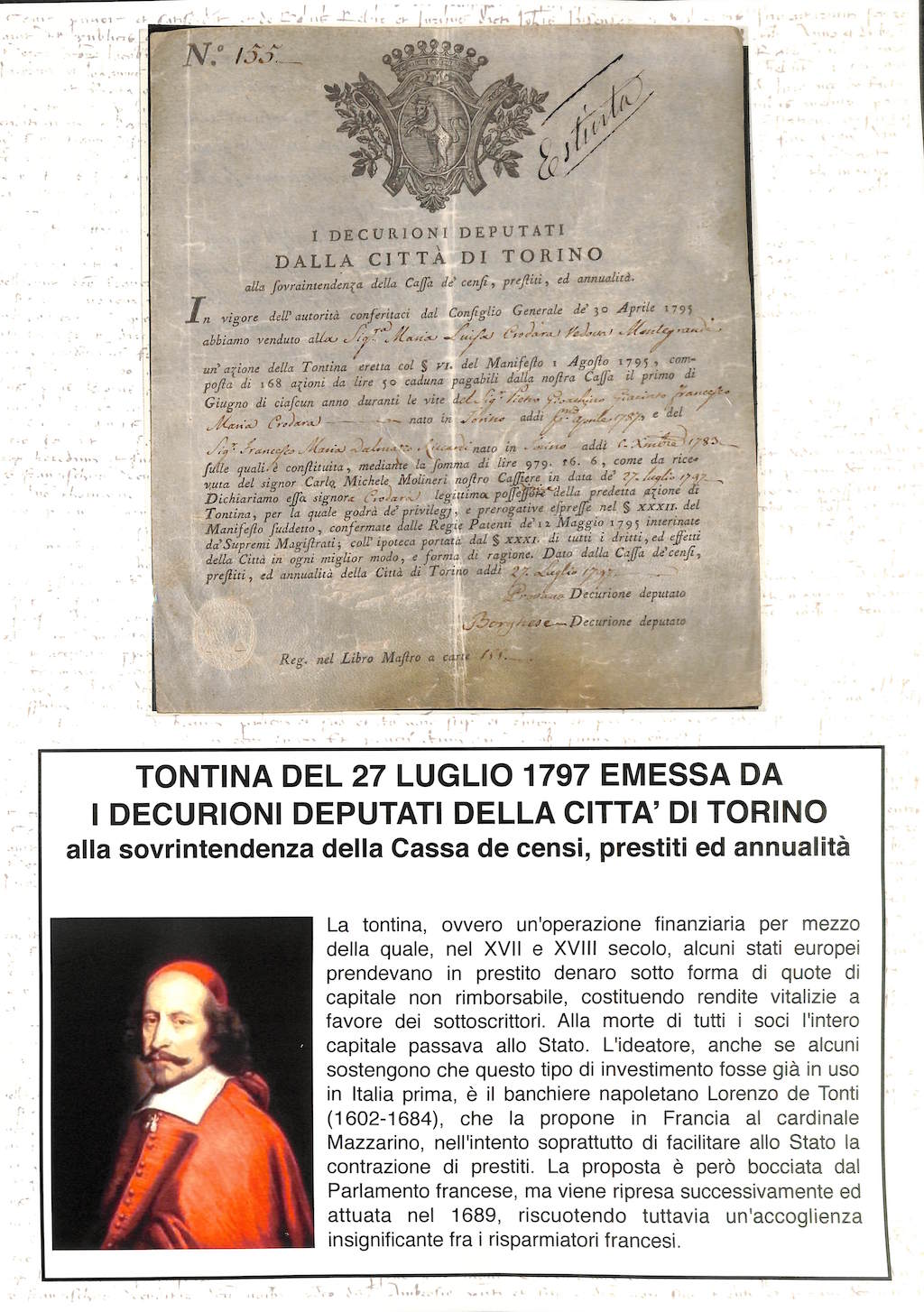 The Treaty also established the new general organization of the Holy Roman Empire, in particularly what concerned the German states on the left bank of the Rhine, which would have passed under the French rule. During the campaign of Italy, Napoleon demonstrated for the first time his great ability as a strategist and commander reaching, despite the limitation of his means, a series of brilliant victories that allowed him to establish French rule over most of Northern and central Italy. The market price of the tontine in question is around 5 thousand euro but, being an extremely rare share, it may represents an interesting purchase to insert in your own collection for future revaluations.