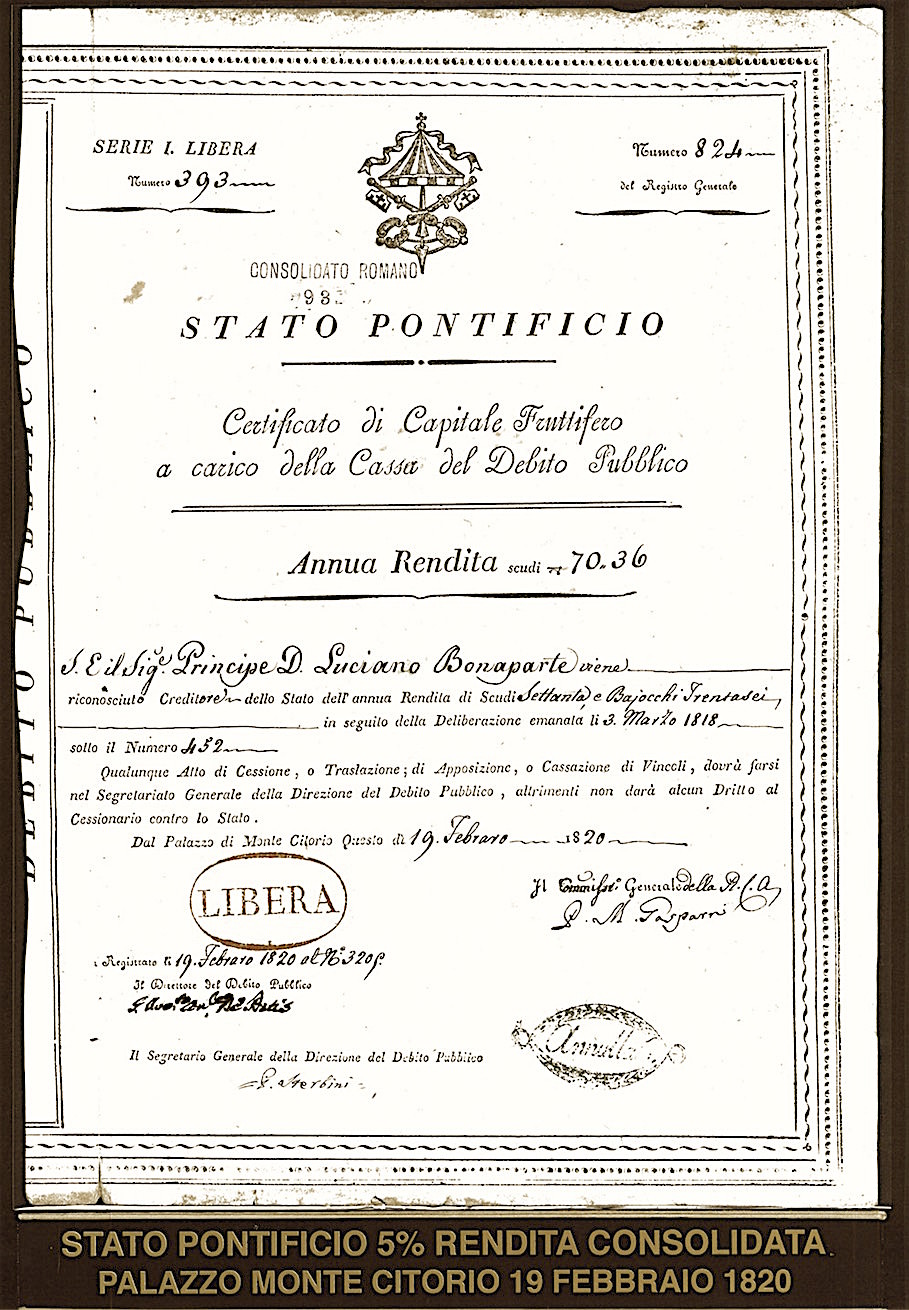
The story of Luciano Bonaparte, Napoleone’s brother (born in Ajaccio on 1775), is tied hand in glove with that of the Papal State. Also the share certificate of which our section is taking care of, testifies it. The authentic certificate of interest-bearing capital , dating back to 1820, resolves that Luciano Bonaparte is recognized creditor of the Papal State of seventy shields and 36 baiocchi. But it’s in 1804 that the destinies of Luciano Bonaparte and the Papacy are inextricably linked. Luciano, widower of his first wife Christine Boyer, married Alexandrine de Bleschamp, widow of banker Jouberthon, entering for this in collision with his powerful brother, who had other plans in mind for him.
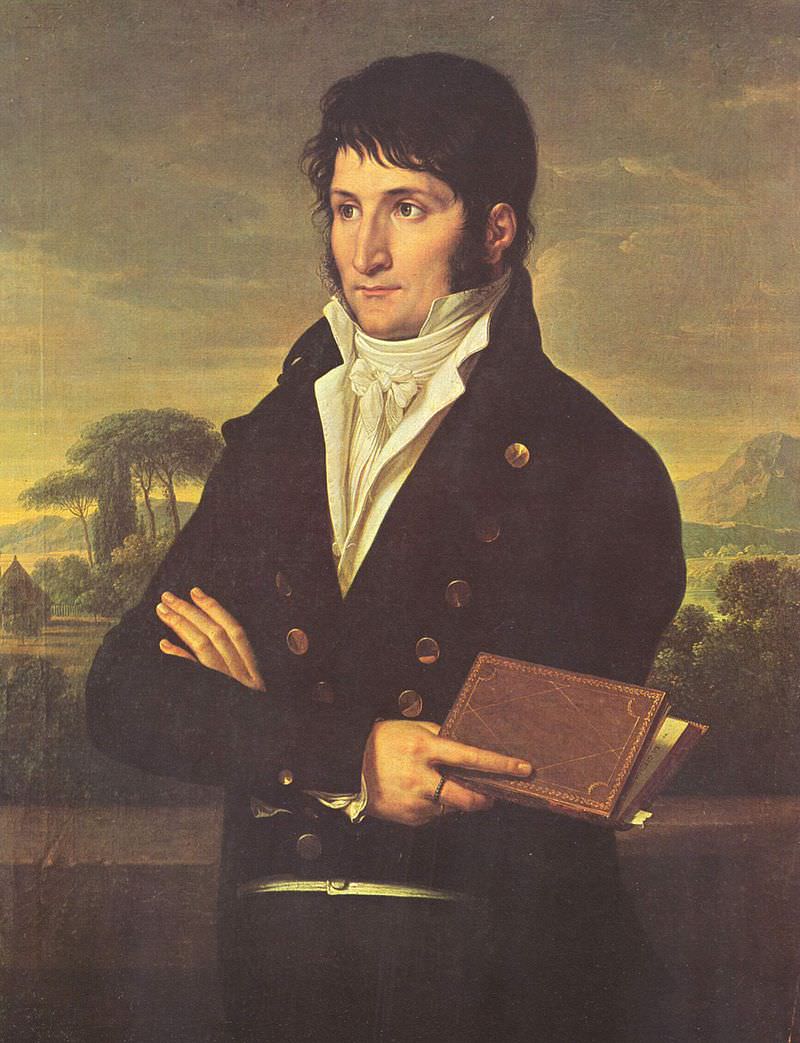
The break is consumed in 1804, when Luciano is forced into exile and to move to Rome. Here he instills friendship with Pope Pius VII, arguing in 1801 the need for a concordat regime between the French Republic and the Church. He settled in Canino (Viterbo), so the Pope then rises to a Principality for him. Luciano Bonaparte, as well as being a fine man of letters, is also one of the most important industrialists of iron of the Papal State in first half of nineteenth century. In the first decade of 1800s in fact, he created a complex in Tivoli in Villa of Maecenas in his property, located on the Tiburtino hill near the ancient Via Tiburtina, taking advantage of the huge canal that crossed it. The plant included a melting furnace, two ironworks, a blade factory and a nailery. In 1809 there was the annexation of Rome and the Papal State to France, and this forced him to a sort of house arrest so that he was obliged to seek authorization from the French military governor for any act. In 1810 he managed to embark for the United States, but the ship on which he was traveling was intercepted by the English, who transferred Luciano Bonaparte to Worcestershire, where he enjoyed a certain freedom of movement so that he worked on a poem whose subject is Charlemagne.

During that period of forced residence, a tenth child is born, Luigi Luciano (the sixth with his second wife). In 1814 he left England, after his emperor brother was exiled on Elba Island. He reconciled with his brother when the Hundred Days started, and after Waterloo he retired first in England and then again in Rome. In that year Pope Pius VII appointed him Prince of Canino. Proscribed by the Bourbons during the Restoration, he settled in Italy at his residence in Canino. On March 21, 1824, Pope Leo XII also bestowed him the title of Prince of Musignano and in 1837 Pope Gregory XVI appointed him Prince Bonaparte. He spent the rest of his existence between Canino and Viterbo, where he devoted himself to archaeological studies and art collections. Luciano Bonaparte died in Viterbo on June 29, 1840 at age 65. His body is still in the family chapel in the Collegiate of Canino. Returning to the pontifical document in question, we note that it is printed on parchment paper. Its size is 28 centimeters wide and 38 tall with handwritten signature of the General Treasurer and the Director of the public debt and bears the emblem of the Reverend Apostolic Chamber. Its catalogue value is extremely low: only 220 euro. (the unique document in the photo below made out to Luciano Bonaparte has a market value of around 1.000 euro as made out to known name). Pontifical Documents on this level enrich and give prestige to collections. Not only: the revaluation over the years of such a rare piece is ensured. The place of issue of the Papal State’s document is Palazzo Monte Citorio.